Robinson Memorial Lecture.
From the Sweet Track to Glastonbury Lake Village: the prehistoric archaeology of the Avalon Marshes – Dr Richard Brunning -Thursday 8th October
The Village Hall was filled to capacity as Dr Richard Brunning took his audience on a fascinating journey through the prehistoric landscape of the Avalon Marshes, tracing its development from the earliest communities to the Iron Age. The exceptional preservation of organic material in the waterlogged peat has provided archaeologists with a remarkable insight into the lives of people who lived in and around the wetlands. Particular attention was given to the Sweet Track, constructed around 3800 BC, and to the network of prehistoric trackways which reveals how people travelled across and used the marshes. The talk then moved forward to the Iron Age and the remarkable settlement at Glastonbury Lake Village, whose excavations have revealed buildings, tools and everyday objects providing an unusually detailed picture of prehistoric life. Dr Brunning also explored how the landscape itself changed over thousands of years, and how modern archaeological techniques are enabling us to understand both the environment and the people who lived in this extraordinary Somerset landscape.
The U-Boat War 1939–1945 – James Porter – 10th September
James Porter began his talk with the development of Germany’s submarine arm and the problems faced by the German Navy in building a force capable of threatening Britain’s vital maritime supply routes. He then examined the changing rules and practice of submarine warfare and the increasingly effective U-boat campaign which developed after the outbreak of war. Particular attention was given to the period when the U-boats posed their greatest threat, during 1942 and into the first half of 1943. The talk also considered the German wolf-pack system of concentrating U-boats against convoys and the continuing battle between submarine tactics and the increasingly sophisticated methods employed by the Allies. The eventual defeat of the U-boat threat resulted from a combination of factors. These included radar, ASDIC, HF/DF, improved depth-charge tactics, long-range aircraft, escort carriers and the development of specialist escort and support groups. Intelligence, including the breaking and exploitation of German communications, also played an important part. His conclusion was that, although the losses inflicted on Allied shipping were enormous, the campaign ultimately failed to cut Britain’s maritime lifeline and prevent the Allies building up the forces necessary to take the war back to continental Europe.
The Mayflower Connection – Helen Baggott (The Postcard Detective) – 11th June
Helen Baggott explored the life and legacy of Priscilla Mullins, one of the most famous passengers on the Mayflower. Beginning with the surviving historical records of the Mayflower, she traced Priscilla’s journey from a young emigrant in 1620, through the loss of her family during the colony’s first winter, to her marriage to fellow Mayflower passenger, barrel maker John Alden. Alongside the documented history she created a second story about how, much later, postcards were sent that depicted images connected with the Mayflower, but with their own individual narrative. These postcards reveal less about the seventeenth century but more about the ways in which people in later generations celebrated, interpreted, and embroidered the Mayflower story. Mention was made of the influence of Henry Wadsworth Longfellow’s poem The Courtship of Miles Standish, which transformed her into a romantic heroine and helped create one of the best-known legends of early America. Although little survives in Priscilla’s own words, official records reveal a woman who overcame immense personal loss to become a matriarch of colonial America.
Town Criers – a history – Janet Seaton & Barry Winetrobe – 14th May
Janet described how town criers have existed since medieval times, when few people could read and news had to be announced aloud in public places. Earlier street officials included heralds, bellmen, watchmen, and messengers who walked the streets ringing bells to attract attention before giving warnings, announcing curfews, reporting fires, or sharing local news. In the West of England, especially in Somerset, Devon, and Dorset, town criers were important figures in many busy market towns. They announced fairs, royal news, local news and civic events, serving as the public voice of local authorities. Town criers are known for their colourful regalia, often including a braided frock coat, tricorn hat, white gloves, ceremonial chain, and brass handbell and their dress reflects the dignity once attached to the office. Today, town criers mainly perform ceremonial and community roles and appear at festivals, parades, charity events and civic celebrations, helping preserve local traditions. Competitions between criers remain popular, with judging based on clarity, diction, volume, and costume (the latter being Janet’s speciality).
The Hidden Story of the Repulse of the Spanish Armada – Dr Justin Newland – 23rd April
Not really a “hidden story” – Justin Newland suggested that reality is cyclical, perception is unreliable, and history may be repeating in ways we do not fully understand. The Spanish Armada was launched by Philip II of Spain against Protestant England under Elizabeth I. Driven by religious and political tensions, Philip aimed to depose Elizabeth and restore Catholicism. Conflict had worsened due to English privateers like Francis Drake attacking Spanish ships and England’s support for Dutch rebels. The Armada, about 130 ships, planned to escort an invasion force from the Netherlands, but English attacks – especially at the Battle of Gravelines – forced it to retreat. Storms then destroyed many ships, resulting in total failure. Justin added thematic depth to his talk using the figure ‘8’. The 8 fire ships used at midnight (8 bells)in the Battle of Gravelines on 8 – 8 – 1588 and other associations such as the figure of 8 course the Armada took, after defeat, via the North of Scotland and Ireland.
Psalms, Palms, Passion and Politics – Canon Rev Brian Pearson – 26th March
Brian Pearson explained the geography of the “Holy Land”, the land of “Milk and Honey”, how important it was to the people who inhabited it and how they yearned for a return to the good old days of the Hasmonean Dynasty (140-37BC), an era of political, religious, and cultural independence with rulers acting as both kings and high priests, blending religious and political power.
Internal conflicts weakened the state, leading to Roman intervention in 63 BC when they captured Jerusalem, where the Holy Temple was a central religious site for Jews. Kings eg Herod were appointed by the Romans. During festivals such as Passover pilgrims would bring offerings, participate in prayers, and join in festival rituals. Palms, innocent-looking but symbolising hope for liberation against Roman authority, would be waved (hence “Palm Sunday”).
For over 2,000 years this region has been a crossroads of conquest, occupation and conflict, contested and turbulent; today, despite modern states and borders, the region remains marked by persistent tension, struggle and instability. This compelling and insightful talk was both absorbing and thought-provoking.
West Country Spas – Sam Hunt – 26th February
Sam provided his audience with an entertaining and fascinating journey through the history of local spas (Bath, Cheltenham, Sidmouth, Hotwells et al), which started of as places of Celtic or Roman worship and developed through stages of offering cures to centres of entertainment and holidays. Using well-chosen contemporary illustrations we saw the use of thermal baths for cures and, as transport systems improved, the opening of the towns to visits from a wider social range – culminating in a 1920s cartoon of The Man Who Asked for a Double Scotch in the Bath treatment rooms! Sam touched on the possibility that some places might have genuinely cured lead poisoning, but also showed us the unlikely claims that some spas made for their waters.
The Mapping of Somerset – Joe and Christine King, Pilton History Club – 22nd January
Joe and Christine gave a stimulating talk and also brought along an extensive array of maps which were eagerly scrutinized later. The mapping all started with Christopher Saxton’s county map of Somerset, published in 1575-79 as part of his Atlas of England and Wales. This was the first printed map of the county and formed part of the first systematic national survey, establishing a durable framework for later cartographers. Saxton’s plates were repeatedly copied and adapted during the 17th and 18th centuries, attesting to their authority and longevity. 17th century mapmakers such as John Speed refined Saxton’s work by adding historical, heraldic, and urban detail, blending geography with antiquarian interests. Later in the century, John Ogilby’s Britannia (1675) marked a shift toward measured road mapping, emphasising movement and connectivity rather than static territory. Eighteenth-century maps of Somerset combined county and road surveys with improved surveying techniques. Notably, railways are entirely absent from these maps, their later appearance in 19th century cartography underscored the dramatic transformation of transport and three-dimensional representation after 1800.
Making Faces at the BBC – Jill Hagger (Lawson) – 4th December
How to start this summary? Something entirely different for Christmas or we have considerable hidden talent in the village. Jill Hagger gave us a fascinating talk on being a make-up artist or rather make-up designer for television and films. She started with a resume of her extraordinary career highlighting some of the major productions she had taken part in and headed and also the many international artists she had worked with. We were then taken on an intriguing tour of the many facets of the art from making wigs, facial reconstruction, body art through to blood and gore and prosthetics. With some interesting anecdotes about what goes on to prepare the actors for their moment on the screen, we also learnt a little about their hidden personas. On You Tube there is an interesting interview with Jill entitled ‘An Interview with Jill Hagger (The Unsung Heroes of Doctor Who) which is well worth the watch.
The Southwest Heritage Trust and its Museums of Somerset – Susie Simmons – 6 November
This month we had a talk by one of our most enthusiastic speakers about a subject of very local Somerset history. Susie started by explaining how lucky she is to have such a fascinating and rewarding job as Operations Manager for South West Heritage Trust – a job that enables her to reach out and foster similar enthusiasm in all ages but particularly the younger generation. She then went on to talk about the three museums in the trust; The Museum of Somerset in Taunton, Somerset Rural Life Museum in Glastonbury and The Brick and Tile Museum in Bridgwater. Besides these accredited museums, the Heritage also looks after the Avalon Archaeology site with its reconstructions of a Saxon longhall, the dining room of a Roman villa and the current restoration project of their previous Bronze Age hut. The site also includes a full size waterline replica of a Viking trading ship. All are worth a visit as can deduced from the website: Museums of Somerset though the Brick Museum is used as more of an event venue and the web should be consulted before visiting.
Magnificent Women and Flying Machines – Sally Smith – 9th October
The History Club were privileged to have Sally Smith as their speaker for the Robinson Memorial Lecture. Sally is a prolific author who has worked as a journalist for Queen Magazine, Daily Mail, Daily Telegraph, Sunday Express and BBC news. The talk, based on her book, concentrated on the early women pioneers in ballooning, parachuting and fixed wing flight and illustrated how far ‘Women and Flying’ has come with Helen Sharman’s trip to the International Space Station. The link gives a far better synopsis of Magnificent Women and Flying Machines than could be written here and is in the words of Sally herself!

Ashley Jones gave us an absolutely enthralling talk about Field Marshall William
Slim, highlighting how he had great rapport with his troops based on a lengthy ‘apprenticeship’ in the lower ranks and latterly his justified rapid rise to Chief of the Imperial General Staff. William Slim, a highly decorated British military commander is primarily known for leading the Fourteenth Army (dubbed the “Forgotten Army”) to victory in the Burma campaign during World War II.
Born in Bristol, Slim initially worked as a teacher and clerk and was then commissioned as a temporary second lieutenant in the Royal Warwickshire Regiment in 1914, earning the Military Cross at Gallipoli and Mesopotamia. After the war, Slim joined the Indian Army and served with the Gurkha Rifles. During World War II, he commanded the 10th Indian Infantry Brigade and led the 10th Indian Infantry Division in the Anglo-Iraqi War and the invasion of Iran. In 1942, he was sent to Burma to take command of the Burma Corps amidst a demoralizing retreat from the advancing Japanese. After taking command of the Fourteenth Army in 1943, Slim was tasked with retaking Burma and his innovative strategies led to the successful offensive that led to its recapture in 1945. After a brief retirement, Slim was appointed Chief of the Imperial General Staff in 1948 and promoted to Field Marshal in 1949. He served as the 13th Governor-General of Australia from 1953 to 1960.
The first public hint of the existence of ‘The Man Who Never Was’ came in a film of that name in 1956 but it was not until the mid 1980s that factual information and previously highly classified evidence became available. As a young child Kevin Patience was enthused by the story and has made it his passion to establish the truths of Operation Mincemeat. Well, Kevin certainly gave us a most absorbing account of the intricacies of the Operation and the military and covert goings-on to achieve its successful goal. However, Barton History Club had a surprise or two for Kevin that he did not know about when asked to speak to us. The ashes of Charles Cholmondeley, one of the two leading architects of ‘Mincemeat’ are buried in Barton Churchyard and also Charles’ wife, who still lives in Somerset, would likely be in the audience. So it is with a sense of contentment that Barton now knows why the ashes are buried in Barton and Alison Cholmondeley now knows a lot more about her unforthcoming husband’s contribution to saving many Allied lives in the invasion of Sicily in 1943.
From Boy to Man in the Somerset Coalfields – Bryn Hawkins – 8th May 2025
This month we had a fitting reminder that Somerset has not always been a rural county with just a variety of stone quarries. Bryn grew up in a miner’s cottage in the shadow of a Somerset Colliery and spent his working life in the pits. He enthralled us with accounts of conditions in his Grandad’s time to when the last coal was mined in Somerset and of the hardships and conditions that had to be endured. The early ‘mines’ were called adits where coal seams surfaced or bell pits where coal was close to the surface. These methods were abandoned when deep seams were mined and the deepest shaft on the coalfield was at the Strap mine at Nettlebridge which reached 1,838 feet (560 m) and flooding and coal dust explosions in some mines required improved ventilation and pumping engines. Several pits closed in the 19th century as the coal was worked out and those that survived until 1947 became part of the National Coal Board, but the expense of improving equipment and working conditions meant that these too became uneconomical. There is still evidence of the mine workings, with the remains of buildings, spoil heaps and tramways in the area, however, the conversion of Portishead power station from coal to oil and reduced national demand together with competition from more economical coalfields led to the closure of the last pit, Kilmersdon, in 1973. As part of the heritage of Somerset coal mines a number of life size metal figures are being placed in appropriate locations.
Claver Morris – the Doctor’s World at the turn of the Eighteenth Century – Professor Paul Hyland – Thursday 10th April
Professor Paul Hyland gave us a thoroughly absorbing and entertaining account of the life of Claver Morris starting with his birth exactly a year before the end of the Commonwealth. By 1686, as a newly married and qualified physician, he moved to Wells to start a medical practice. He faced many challenges due to limited funds, the absence of hospitals, competition from various local healers and not least many family tragedies. By his death in 1727, he was well-regarded for treating various patients and conditions through his unique methods. His diaries reveal his hardworking and sociable nature, involvement in community projects, and success reflected by his impressive house and estates. This was despite facing personal disputes with some clergy, including the Bishop at Wells, due to his open-minded view on religion. Why did he choose Wells? – his other consuming passion for music.
How to read and understand medieval Latin documents – Rob Butt – 13th March 2025
Rob Butt’s talk on March 13, 2025, discussed how to read and understand medieval Latin documents. He stressed the need to learn Latin grammar and vocabulary, study palaeography, use language resources, and understand the document’s context. Key elements like title, date, author, and recipient should be identified. He explained parts of a charter and the importance of deciphering abbreviations and symbols. Attendees were encouraged to read carefully, take notes, and consult secondary sources for help. The session included practice with entries from the Domesday Book about Barton St David demonstrating how to translate Latin texts effectively. The talk was both engaging and informative
Somerset Churches and Chapels – Richard Raynsford – Thursday 13th February
The History Club is very grateful to Richard Raynsford for stepping in at fairly short notice. He gave us an interesting presentation on the noticeable, less noticeable and idiosyncratic features on some of the county’s places of worship. Concentrating mainly on the Mendips, north Somerset and the Quantocks; we were shown illustrations of external architecture (including graveyards), external adornment and internal design, décor, sculpture and carvings. These were all presented with Richard’s commentary on their origin, significance and possible rationale. His talk certainly encouraged us to take a more inquisitive view when visiting local Churches and Chapels.
“Unravelling the Wonders of Deep Geological Time” – Louis Wheeler – Thursday 9th January
How do you cover 4.5 billion years in a précis of a couple of hundred words? The answer is you do not and I’ve wasted nearly thirty words already! So far we have had talks on only the past few hundred years of mankind’s history but homo sapiens has merely been around for less than the last 0.01% of time since 4.5 bya (billion years ago). Louis Wheeler gave us a fascinating talk on how most of Britain started from Antarctica those 4.5 bya and eventually joined up, mainly along west Scotland, with matter from elsewhere. His tour of the geology of the UK provided an absorbing insight into the origins and history of various regions – a simple rock or boulder will never seem the same anymore. Did you know that dinosaurs were around for about 4% of time; which is a lot longer than we have?
A Christmas Event – Curiosity Corner – Thursday 5th December
The weather seems to want to spoil our Christmas events but yet again it failed. An extremely interesting variety of artefacts and memorabilia were presented. We started with an old poster for a Parish election that had been preserved (rescued?) and named villagers of yore known to some of the audience. Other ‘curios’ ranged from the simple (old sugar tongs and sheep shears), old coins (Roman found in Barton and Edward I used as a teaching aid), the exotic (central American needlework and a metal mask), historic (wartime maps and an 19th century letter collection) and a couple of puzzlements. Before the mulled wine and Christmas season nibbles we had a bier (the spelling is correct!). This was the old village mobile, hand pulled coffin trolley together with its original purchase documents!
“The Battle of Sedgemoor” – James Porter – Thursday 7 November 2024
In 1685, Monmouth, the illegitimate son of Charles II, landed in Lyme Regis with the intention of deposing his uncle James II. He planned to enhance his forces and eventually march on London. His army, including nonconformists, artisans, and farm workers, fought skirmishes with local militias but failed to capture Bristol. Having returned to Bridgwater he led his troops out at night towards Westernzoyland and were guided by Richard Godfrey towards the King’s army. With limited cavalry in the front, they encountered a delay at a rhyne, where a shot was fired by a royalist patrol. The rebels were engaged by the King’s Regiment of Horse, who used their superior training and horses to outflank and defeat the rebel forces. Monmouth’s rebellion ended with this defeat at the Battle of Sedgemoor, and he was beheaded for treason.
The Robinson Memorial Lecture – “In Search of Florence Nightingale” – Dr Ruscombe Foster – Thursday 10th October
Dr Foster started the lecture by explaining that, as a historian, his interest in Florence Nightingale was focused when he became a teacher at Embley Park. Now a school, Embley Park in Hampshire is where Florence spent her childhood. His research confirmed her immense contribution to nursing but also uncovered several misconceptions and myths about her personal life.
Florence Nightingale, born into a wealthy family, was highly educated and intellectually curious. Despite societal norms, she felt called by God to reduce human suffering through nursing. She faced resistance from her family but eventually found success as a nursing administrator in London. During the Crimean War, due to public outcry, the government asked her to improve hospital conditions for wounded soldiers. She lead a cadre of nurses that significantly reduced mortality rates by establishing basic conditions of nursing care. Little is publicized about her life after the war in 1854, but she continued her work until her death in 1910 by advocating social and healthcare reforms and meeting with royalty to bring about changes in military medical systems. As a result of her significant efforts, the Nightingale Fund was established to support her in opening the Nightingale School of Nursing in London. Nightingale’s statistical data collection and nursing concepts revolutionized the field, making nursing a respectable profession for women and solidifying her legacy worldwide as a pioneer of modern nursing practices.
“Enigma & the Bombe” – Thursday 26th September
I think most of us have heard of the Enigma machine which by means of 3 rotors, ‘Stecker’ pairs (which could select 10 letter pairings per day) and a 3 letter start code could produce 159 quintillion combinations. The decryption only worked if sender and receiver used the same settings. Churchill pronounced that unless the Enigma code could be broken the war would be lost and he might as well sue for peace and clearly brute-force cracking of the code could not be done. Frank Falcon gave a fascinating insight into how the code was broken by Bletchley based on some knowledge of earlier machines, the fatal flaw that no letter could be encoded to itself and the considerable assembled brainpower of Oxbridge and other intellectuals. This fashioned the Bombe which used logic to decipher the encrypted messages produced by the Enigma, however, it was human brainpower and understanding that enabled the real breakthroughs. Hitler never admitted the Enigma had been broken but Admiral Doenitz became aware of its fallibility and introduced a 4th rotor for his U-boats’ machines. The ten month lack of intelligence to protect our convoys nearly brought the country to surrender!
“Posted in the Past” – Thursday 27th June
Helen Baggott, labelled the “postcard detective” by the “i” newspaper, has hundreds of postcards but is not a collector! Their quality is not important but what is written on them is. She then researches the lives and stories of the people involved. She explained how her interest in the subject began with her being intrigued to find out something about the recipient of an old WW1 postcard her father had shown her, and how years later she had built this soldier’s family tree and traced the history of the family and its movements around the world. She explained how careful she had to be with any potentially sensitive material in her researches to avoid upsetting any descendants, but how interested many were to learn about their ancestors. It was fascinating to see how many stories and just how much detail Helen’s researches could reveal simply from a name and a few words. Some of these stories are told in her “Posted in the Past” series of books.
“The Marine Aspects of Hinkley Point” – Thursday 23rd May
Not so much history but history in the making – Martyn Sandell gave us a fascinating and entertaining insight into some of the complexities being faced in the construction at Hinkley Point Nuclear Power Station. On the technical side there is the sheer incomprehension of having to build three tunnels, up to 3.5 km long, under the Severn Estuary just to provide cooling. Based on his previous experience in the Police, Martyn also outlined some of the security problems faced. These ranged from control of a large, multinational workforce to which government department had responsibility and authority over the various activities above and below land and sea. In conclusion, how do you stop the cooling system sucking in 9 billion fish over the life of the plant? You could find this out and much more by booking a tour for Hinkley Point C (07813 232358 or email hinkleypointtours@nnb-edfenergy.com)
“Somerset Wanderings” (with a camera) – Thursday 11th April
The world has many famous double acts but Barton History Club has its own special one. The Sellick and Daggar show was another in the series of fascinating photographic tours in Somerset – not your Powerpoint projection but beautiful large prints that can be laid out and enjoyed at leisure. Ranging through Somerset forests, wetlands, moorland and even a couple of museums, the photos showed Bernard and David’s mastery of composition, timing and patience in getting the best ‘shot’. Like royalty, they admitted that they use software help to legitimately enrich what their cameras saw for the benefit of the viewer, without in anyway altering the substance.
“A History of the Measurement of Time” – Thursday 14th March
What is time? For the uninformed, time is the continued sequence of existence and events that occurs in an apparently irreversible succession from the past, through the present, and into the future! Baz Hamblin took us on an absorbing journey through time past from noticing that hot and cold seasons roughly matched a number of light and darknesses to a complicated leap year formula that ensures that our calendar year matches our solar year*. He explained how and why we have years, months, weeks, days, etc., how the months and days got their names and also how the moon’s phases influence the time of Easter and perhaps even gardening**.
And finally, of course, we ended with wine and nibbles.
*To be a leap year, the year number must be divisible by four – except for end-of-century years, which must be divisible by 400. This means that the year 2000 was a leap year, although 1900 was not. 2024, 2028, 2032 and 2036 are all leap years.
**To practice gardening by the moon, you would plant crops like tomatoes, peppers, corn and beans when the moon is waxing. Potatoes, radishes, carrots, beets and other root crops would go into the soil while the moon is waning.
“Glastonbury & Lalibela – contemplations on a shared history“ – Thursday 8th February
Lalibela (for the ignorant like me) is in Ethiopia but this LINK can provide some much needed details for the uninformed! Although the ‘twinning’ with Glastonbury is somewhat vague, David Odgers raised some interesting comparisons with the localities and history of the two sites. Like Glastonbury, Lalibela is suffering the ravages of time, not least the degradation of the basalt construction causing instabilities and latterly global warming which warrants urgent preservation. We were also shown some of the recent attempts at conservation – some rather unsuccessful. Sadly the region is now in a conflict zone and currently, unlike Glastonbury, has no tourism or the income it deserves as a World Heritage Site.
And finally, of course, we ended with wine and nibbles.
“The Global Response to the Population Explosion : Successes and Failures” – Thursday 11th January
Professor John Cleland opened the presentation by indicating how the world population had ‘exploded’ over the past millennium and how it was now rising exponentially through 8 billion. Population control poses a major conundrum to world leaders and we were given several different examples of the various approaches by those in power. Some techniques proved better than others and some proved absolutely disastrous. What is projected is that in the next 30 years the population of Europe is likely to decrease whereas the population of sub-Saharan Africa is likely to burgeon. This concluding prediction prompted a very thought-provoking question and answer session which regrettably had to be brought to a close by the requisite wine and nibbles.
“Christmas Event” The Somerset Russets – Thursday 7th December
Something completely different for our Christmas meeting. An evening of musical entertainment consisting of carols and Christmas songs specific to local areas within the country. This was interspersed with short spoken sketches of amusing anecdotes that happened at Yuletide such as the ad hoc carol singers and the bogus fiddler. As well as audience participation in some of the singing, a thoroughly enjoyable evening was rounded off by mulled wine and mince pies. (Note: Not your usual wine and nibbles).
The Golden Age of Glass – Thursday 9th November 2023
Back by popular request, Dr Francis Burroughes gave us another excellent talk on the History of Glass this time bringing us up to date from the beginning of the 18th century to more modern times. We were told how the advent of coal gas and its ability to produce much higher temperatures led to the production of finer quality glass, mainly centered on Stourbridge; how the addition of different elements to the glass produced different colours (some very surprising) and shown some of the magical effects of relief cut and cameo cut glass. He ended on the sad note of how, in the same period, English glass production had gone from a virtual world monopoly to a mere cottage industry. We also had the same excitement (terror?), as before, of handling priceless and breakable examples of the glassmakers craft.
How pagan were the Medieval English? Thursday, 12th October 2023
The short answer is “not really!”. A full house had an excellent Robinson Memorial lecture from Professor Ronald Hutton which started by de-bunking certain myths such as the Green Man being pagan. The Green Man had several origins but the most appealing was a sprite who lived in the woods and wore a cloak of greenery. Even witches, accused of being non-Christian, were shown to be the victims of malice and so called pagan rituals were no more than drunken revels. Modern thinking on Medieval Paganism mainly originates from a comprehensive study that took place at the start of the century that showed that, once the English had embraced Christianity, the only real pagan threat came from the Viking invasion. By the Middle Ages, Christianity had comprehensively replaced several pagan gods with one God and 3 types of Saints: Accredited (the Apostles), Assigned (patron saints of crafts, ailments, hopes, etc.) and Regional (typically St Enodoc and St Ives). Women also played a large role in the Church with women’s guilds and as churchwardens. Then came the Reformation, the Church became male dominated, saints were shelved and religion was simplified but it generated different types of worship such as presbyterian, methodist, evangelical, etc. In 2021 we had 46% professing to be Christian, 37% no religion and the rest 17% (Buddhist, Hindu, Jewish, Muslim, Sikh, others and don’t knows) – but we all celebrate Christmas!
Glastonbury Myths and Legends – Thursday 28th September
So the sun does not go round the earth – but in days of yore it was believed as fact. The same can be said for some of the Glastonbury Myths and Legends as we learnt from our guest speaker, Michael Orchard. Did the countenance divine shine forth upon our clouded hills? Were Arthur and Guinivere buried in Glastonbury? Did Joseph of Arimathea visit with the Holy Grail and did his staff become the Glastonbury thorn? These and other fables were originally accepted as truths but have since become legends … or are they still believable? And finally, of course, we ended with wine and nibbles.
Wells Cathedral High Tour Tuesday – 18th July 2023
A group of members enjoyed a fascinating trip to Wells Cathedral to explore the magnificent building from a very different perspective as we climbed the winding stairs to the galleries and on up into the central tower. We were guided by a true expert on the architecture and history of the cathedral who pointed out the various stages of construction and highlighted the masons marks and many features of the building which we would never have spotted without his guidance. We were intrigued to learn about William Joy the fourteenth century master mason who identified the leaning of the central tower and supported it with the scissor arches which look so modern that is said that one recent visitor apparently thought they had not been there on their last visit! This was a tour we would recommend to anyone who can manage the steps!
Villa Ventorum – A Roman Villa Reimagined – Thursday 22nd June
We broke for the summer season with an excellent presentation by Ric Weekes on the Villa at The Newt. He enthralled an audience of thirty with his description of the archaeological evidence of occupation in the area from tribal groups to Roman dissolution in about 500AD. He explained how the finding of artefacts and a mosaic floor on The Newt site generated the idea of unfolding and recording the history of the immediate area. Considerable painstaking archaeological research, attention to detail and modern technology, including virtual reality, has come to fruition in the superb project instituted as the Villa Ventorum.
Fact or fiction? Somerset and its legendary kings Arthur and Alfred – Thursday 4th May
An excellent talk by Andrew Pickering that left the full audience somewhat disillusioned. Arthur is wholly legendary and Alfred was not Great. There may well have been an influential warlord, not called Arthur, in the area in the dark ages but the stories of his exploits, knights, wife, swords, table, wizards, etc. are but the product of imaginative medieval raconteurs. These tales of derring-do were further enhanced by more latter day fantasists. This is not, however, to say that there is no evidence in the south west of some local chieftain or chieftains whose exploits may have been worthy of recording. King Alfred the Great is the product of what is now termed ‘spin’! Alfred proclaimed his own greatness and this was supported by the writings of his loyal sycophant. Subsequent dynasties used links to his greatness to further their own ambitions. This is perhaps typified by the somewhat strange King Alfred Memorial in Swanage with its 4 Crimean cannon balls. Erected in 1862 it is “In commemoration of a great naval battle fought with the Danes – in Swanage Bay by Alfred the Great. AD 877”. Factual history indicates the Danish fleet of over 100 ships was lost in a storm! And finally, of course, we ended with wine and nibbles.
Battle of Britain over Somerset – Thursday 13th April
There are about 5,000 John Smith’s in the UK but the History Club was lucky enough to have the one that has an encyclopaedic knowledge about the Battle of Britain over Somerset and the West Country. By the sheer weight of the factual evidence he revealed, he totally shattered the popular belief that the Battle of Britain was fought entirely over the Home Counties. The full audience were entertained and not a little surprised by the multitude of raids, after the fall of France, between Portland in the east, Plymouth in the west and all places north to Bristol and beyond. All this was enhanced by a display of models of the aircraft from both sides that were involved and information on their various assets and weaknesses. And finally, of course, we ended with wine and nibbles.
A Photographic Exploration of the Rivers and Canals of Somerset – Thursday 9th March
Somerset’s waterways may meander sedately through the county and may not have tumbling cascades or fast flowing rapids but explore a few steps nearby and, if you know where to look, there is a wealth of history. Take a camera and share your discoveries with others in the form of spectacular photographs. Bernard Sellick and David Daggar do just this and showed us pictures of pumping stations, a corrugated iron Church, old quays, rail bridges and canal locks to mention a few. Together with views of beautiful countryside, all of this was accompanied by a host of interesting information and mention of the antics sometimes necessary to get the optimum portrayal and composition – not forgetting the requisite celebrity swan in the foreground.
Dairy Farming – a high tech industry with a rich heritage. – Thursday 23rd February 2023.
A fantastic turn out for a subject very much to the heart of most local residents. Where have all the cows gone that were herded round the village and what sort of life do they lead now? Duncan Forbes explained the reasons why so many farmers have left the industry and illustrated the major steps that had been essential to keep dairy farming viable. Many of the ‘high tech’ innovations that are developed at the Agri-EPI Centre South West Dairy Development Centre at Beard Hill Farm near Shepton Mallet were explained. Possibly the most important message was that despite the drive to improve efficiency and increase milk yields the welfare and stress-free life of the animals is of paramount importance. After the talk we were treated to cheese tasting and it was noted that the Barber’s 1833 vintage reserve cheddar was long gone before the others!
Somerset Cider and Wassail – Thursday 12th January
A talk about cider in the county of cider from a man who knows. Alan Stone has been making his own cider and selling it locally for over 30 years. We were told about the history of wassailing and how it perhaps owed its origins to many other customs. It only really had a resurgence in the second half of the 20th century when one large cider producer saw it as an advertising ploy and was soon followed by others. Anyway it’s nice to find some entertainment in the bleak days after Christmas even if it is singing to apple trees in the cold and dark! We also sampled some really smooth, last years’, still cider – scrumptious. Then we had our usual nibbles and wine and a chance to chat to the speaker.
A bitterly cold night, no guest speaker … so not much of an event then! An evening of self-entertainment ranging from the ancient to the fairly modern and including the strange, useful and artistic. Members of the audience brought various items of interest and explained their history – some factual and some anecdotal. We saw ancient fossils found locally and a piece of the iron curtain from the 20th century. We saw carved heads from the South Seas, a replica of a Henry Moore statue that once stood outside Clarks, pictures of a ‘lost’ Barton bridge, a WW2 army compass, a very upmarket boys’ outfitters catalogue from the 19th century, a piece from a French royal throne, a pike-head probably hidden by a rebel after the Monmouth Rebellion, a 100 year old Devon rugger cap, a poster from 1911 advertising a sale to help fund the restoration of the church bells and more. (Sorry if I left out your item – there were so many and all were interesting, Ed.) After an absolutely enthralling miscellany we then set about the mulled wine, canapes and mince pies – who says village life is dull? It was a super evening.
Falklands Reminiscences – Thursday 10th November
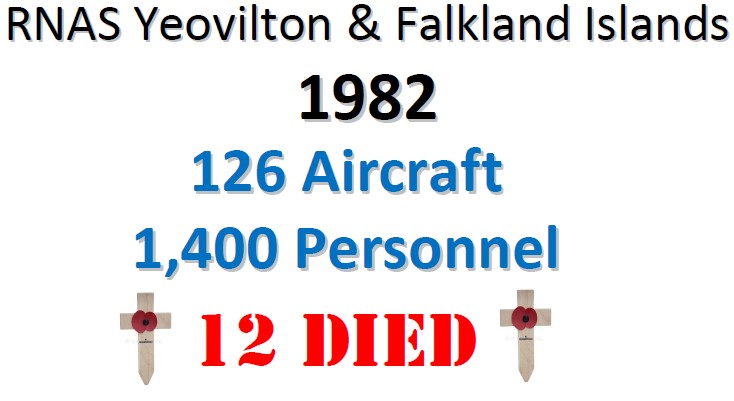
Paul Eitzen bravely stepped into the breach at 36 hours notice after our booked speaker was unable to come to Barton and gave us his personal account of his service in the Falklands War when he was responsible with a small crew for the maintenance of 20 Wessex 5 helicopters which mostly came from Yeovilton. He entertained us with his tales of the ingenuity of his “Mr Fixit” and the informal trading arrangements which sprang up between the different forces eg chocolate swapped for wild geese from the Royal Marines and then the geese swapped with the Chinese merchant crewmen on the Fleet Auxiliaries for vegetables … all parties then happy with their food! Paul illustrated his talk with a slide presentation and with souvenirs he had brought home with him on his journey back to England under medical supervision. He was then happy to take questions from the large audience over drinks and nibbles.
The Peter Robinson Memorial Lecture – Thursday 13 October. Dr Ian Mortimer, who was chosen by Peter before the COVID crisis to deliver a celebration lecture to the Barton History Club, proved to be a formidable lecturer. He spoke without notes for ninety minutes, quoting details and dates in support of his thesis that the Middle Ages saw an expansion of horizons – personal, spiritual, geographical, commercial, educational etc – like few if any others in human history. He had his audience riveted throughout, and then answered many further questions after the talk.
Many thanks to everyone who helped to make the event such a success – Penny and Paul for advertising, Carolyn for dealing with all the tickets, Val for hosting our visitor, Peter for videoing the whole meeting at very short notice, and Barry for his introduction. We were so sorry that Penny, Peter’s widow, was not well enough to attend, but her message was very welcome, and Peter Farrant’s efforts meant that she had a recording to view immediately.
On Thursday 8th September we had an excellent talk about the History of Glass by Dr Francis Burroughes. It covered glass making from Roman times to the start of the last century. As well as giving us fascinating facts about the production, colouring and centres of excellence, the talk was delivered very professionally and with a dry wit. But beware, if you are privileged to attend one of Dr Burroughes’ talks you will be invited to handle pieces of priceless (and breakable!) glassware.
Our speaker on Thursday 26th May was Paul Eitzen who gave us a fascinating talk on Barton Church, its history and the background of its most interesting features and furniture, from the bells to the squint from the bell tower and its unusual layout with a north door. Paul amused us with his healthy scepticism of totally inaccurate press reports about theft from the church which appeared in different papers, and of the wildly exaggerated numbers of members of the Adams family who were reported to have visited the church to see the plaque about Henry Adams, whose descendants John and Quincy Adams were second and sixth American presidents. Paul’s talk will certainly make us open our eyes on our next walk around the church.
On Thursday 28th April our speaker Kate Lynch gave us an interesting talk on “The Old Crafts of Somerset”. It covered a multitude of crafts including such diverse activities as paper making, dry stonewalling, weaving, basket making, and pottery as well as the more well-known – horse shoeing, thatching and cider making! These were illustrated with photographs of Kate’s paintings and charcoal drawings of the craftspeople which, along with their stories, are in her beautiful new book “Craft”
On Thursday 17 March 2022. If you were not there, you certainly missed a memorable evening. The Russets honoured the Barton St David History Club with the first public performance of their new programme of Somerset music from the 18th century onwards. The comment that best sums it up was “That’s the most enjoyable history lesson I have ever had”. We were entertained by an extremely professional musical performance punctuated by mini playlets by members of the orchestra putting the music in context, identifying which part of Somerset it originated and who was the composer or collator. They also gave a flavour of the contemporary musical scenes and some of the local reactions. Before the usual wine and nibbles we stood whilst the Russets played the Ukraine National Anthem. All the donations from the evening came to £250 and have been donated DEC Ukraine.
On Thursday 17th February our speaker was David Lawson who had us all intrigued by the title of his talk ‘Dating Historic Buildings – just not marrying them!’. We were given thoroughly entertaining talk which including a brief history on how an inventory of buildings originated but focusing on the time line that brought in the ‘listed’ buildings (to be more precise listed structures) as an entity, how it was implemented and what it covered exactly. Concentrating mainly on the listed buildings in Barton we were enthralled by tell-tale signs of how much buildings changed over the years and also how the changes could be dated fairly precisely by the style of architecture prevailing at the time and the materials used. David also gave us some anecdotes on how the ‘listing’ was done in Somerset and some amusing examples of questionable documentation.
On Thursday 20th January. Our speakers to start the new year were Bernard Sellick and David Daggar who gave a fascinating talk titled ‘A Photographic Exploration of the Somerset Coast’. Clevedon Pier to Porlock Weir was covered by a series of photographs, considerably enlarged to show great detail. Not your happy snaps these – more your gallery prints. The real attraction of the presentation was in the background information on areas not normally visited and historic sites/sights not usually seen. This has definitely prompted several members of the audience to plan trips to explore our lovely coastline.
On Thursday 16th December. Our speaker was John Dando on ‘A Walk up the Garden Path’. Despite the natural apprehension about the latest Covid increase, there was a respectable and suitably masked audience that was entertained by a light hearted but factual history (all in the best possible taste) about the privy in Somerset. We all learnt some interesting facts about this essential facility which will no doubt stick in the mind. Even the members expecting a horticultural talk were not disappointed with something a bit more agricultural!
On Wednesday 10th November our most recent speaker was Andrew Pickering on ‘Witchcraft Belief & Accusation in 17th Century Somerset‘. He entertained us with fascinating stories about Witchcraft around the Frome area, particularly in nearby villages. His obvious enthusiasm for his subject has led him to seek factual and recorded evidence of ‘apparently’ bizarre events and to seek explanations as to why and how they had occurred. He further explained the rationale behind the punishments meted out and why witchcraft ‘belief’ had virtually died out by the end of the century.

On Thursday 14th October we had a talk by Christine King about Annie Nash – An Early Somerset Photographer. Annie died in 1976 having dwelt all her life in the Glastonbury/Shepton Mallett area. For her time she was an accomplished photographer and her record of Somerset life and people in the late 19th and the majority of the 20th century is fascinating. We were also privileged to see some of her historic memorabilia including her glass slides, intricate wood carvings and her husband’s war diary. Our meeting on Thursday 23rd September in the Village Hall was an EGM and a session called “Making History”. This enabled us to properly discuss how we go forward and also to gather everyone’s thoughts about how the pandemic has affected us ….both positive things and negative. We plan to collate a record of a truly historic period which, hopefully, will be of great interest to future generations of Bartonians On Thursday August 26th we visited West Camel for a gentle self-guided tour of their Village Trail followed by refreshments at the local pub.
VJ Day Commemoration in Barton St David August 15 2020. A short Remembrance Service was held at the War Memorial in rather wet conditions. Photographs and a transcript of Janet Powell’s moving address are at the title link. February 2020 .Wednesday 19th , Village Hall, 7.30pm. Peter Farrant and Gill Hooks presented film show about ‘The Butleigh Heritage Trail’.…. Squire Neville Grenville’s steam car; Ann Heeley’s pioneering local history studies, the memorable BBC ‘History on your Doorstep’ Housego / Heeley interview, 2019 grand opening of the village Heritage Trail. 31 Members and visitors attended. The pics below tell all – a very enjoyable evening.


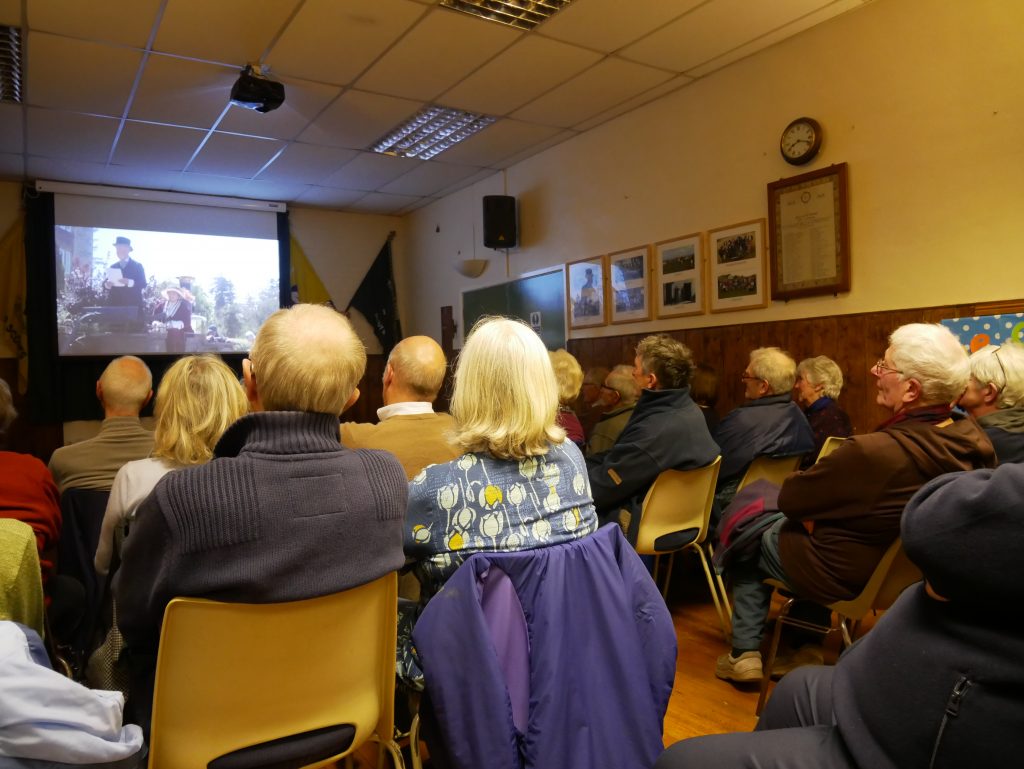
January 2020. Wednesday 22nd, Village Hall, 7.30pm. ‘Early Somerset Photographers’. Phil Nicols gave a fascinating illustrated talk based on his, Robin Ansell & Allan Collier’s long term research and book ‘Secure the shadow, Somerset Photographers 1839 – 1939’. We were delighted to welcome the irrepressible Peter Farrant back from his hip operation and, big surprise, Rob Butt who received a round of applause. Attendance 30, Members and 4 visitors.
December. Wednesday 11th, Village Hall, 7.30pm. With 40 in attendance, Bill and Kaye (Alyce) Wych presented their new dramatic findings of ‘ Glastonbury after the Dissolution’. Playing the part of Abbey retainers now bereft, in a strange world and changing religious regime, the Wyches explained their fears, laid bare the woes of both themselves and their fellows living in the ‘Street’ (town). Dennis Powell introduced the Wyches and reminded us of their 2014 appearance in the ‘Abbot’s Supper‘ performed in the Glastonbury Abbot’s Kitchen. Seasonal fayre followed with mulled red wine and apple juice.
November. Monday 18th, Village Hall, 7.30pm. After many years as the high profile manager of Strode Theatre, Street, Liz Leyshon‘s talk appropriately, was called ‘Behind the Scenes‘ – a lot was revealed. 31 members and visitors heard about Liz’s encounters with visiting stars like Ken Dodd (who joked about the way HMRC treated him since he maintained he had invented self-assessment), John Mills, Rostropovich….the list is endless. She was forthright about the architects, builders, Crispin school heads during Strode’s 50 year development period. It was a riveting slide show followed by BHC’s usual bonhomie.

October. Wednesday 16th Village Hall, 7.30pm. Liz Copas, a world authority on apples, gave a talk telling the fascinating story of ‘The Apple Road. How apples came to Somerset’. 57 Members and guests attended. Liz explained how apples of Chinese origin travelled along the ancient trade highways often in the stomachs of horses; how Greek and Roman gardeners improved these stocks and brought them to these shores. Liz was involved with the work of the Long Ashton Apple Research Station for many years and Bristol University’s brilliant Dendrology research. The meeting concluded with animated chat, munching apple tart and supping Hecks sweet cider.
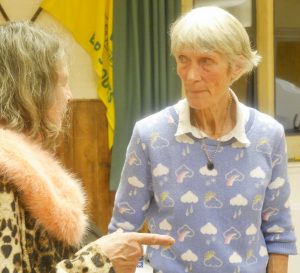
September. Wednesday 18th, Village Hall, 7.30pm. David Daggar gave a fascinating illustrated talk on Windjammer Inverneill, the story of its sailing career 1830 – 1930 – the people and life on board, the rounding of the Horn and other voyages. Only 10 attended this carefully researched presentation prompted when David inherited the windjammer captain’s travel trunk. Appropriately after, a glass of grog & tasty ship’s ‘biscuits’ were enjoyed by all.
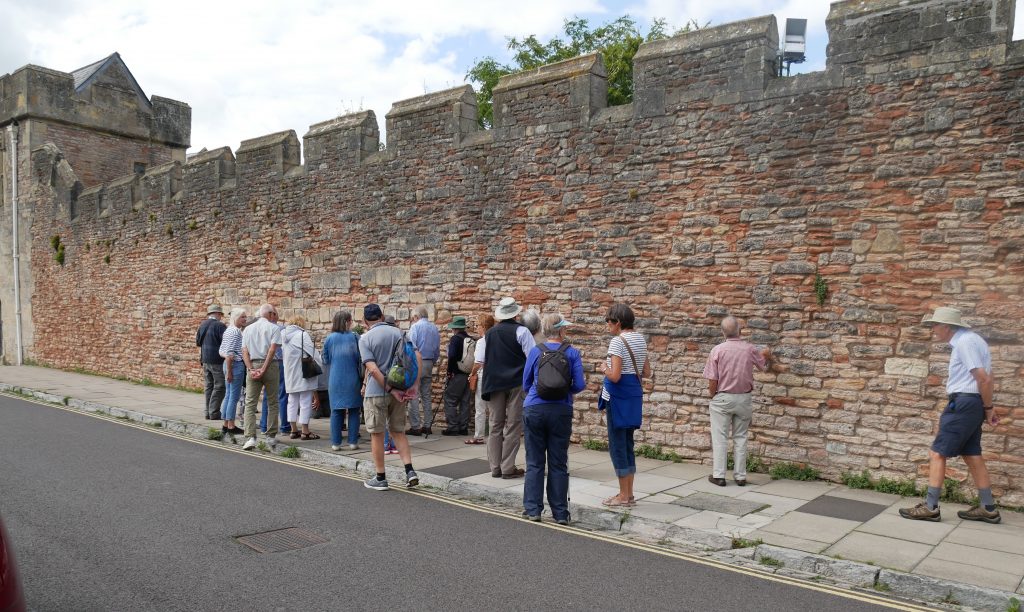
August. Wednesday 21st . Geological tour of the City of Wells. We met at 1.45pm at the West Door of the Cathedral. After a short introduction using notes previously emailed to everyone, our geologist guide, Dr Doug Robinson took 24 Members and guests round 15 stopping points to study the stones used in the buildings and walls – aged from 300 million years to 100 million years old. We all agreed after that we would never look at buildings in quite the same way again ! And then, weary, we enjoyed tea and cakes in Café 21 on Market Square served – coincidently – by Hannah a delightful student geologist just graduated at Imperial College.
July. Saturday 20th. Barton Carnival. The History Club shared a table with the VHPF, waylaying visitors coming for tea and cakes. BHC sold 2 Tithe Maps and 8 Barton Moment in Time booklets. A productive and enjoyable afternoon. Thanks to all Club Members who helped man the stand.
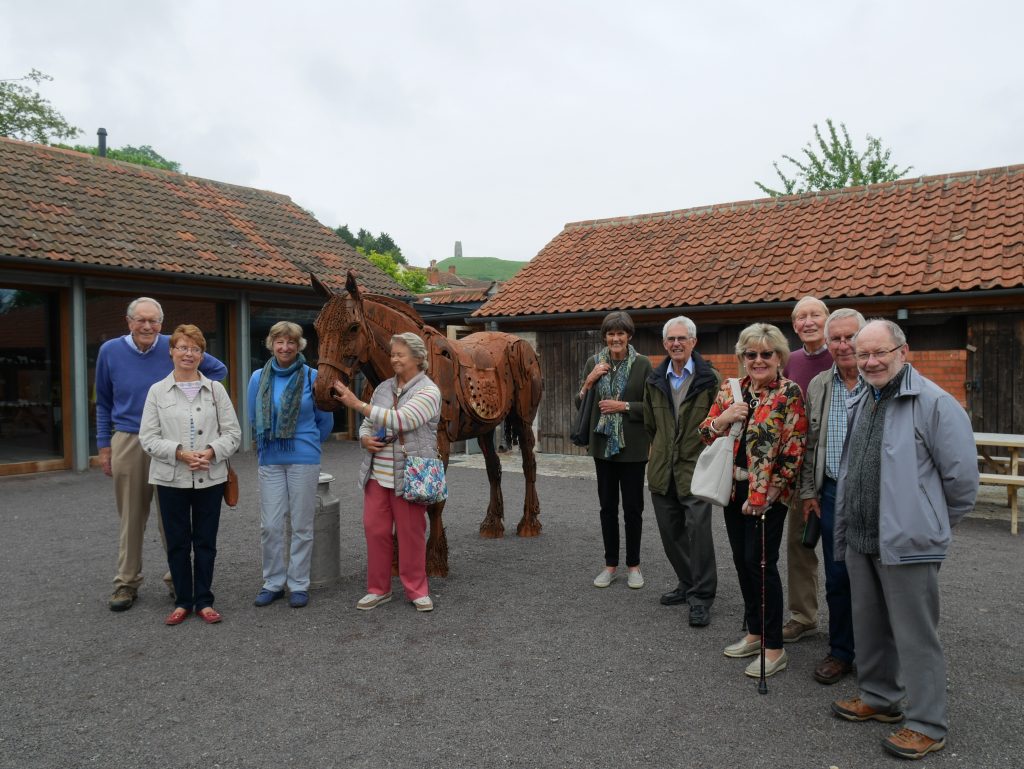
June. Wednesday 19th. Guided tour of Somerset Rural Life Museum. Our delightful guide, Polly, recounted the history of the site from being an Abbey farm to when it was owned by the Mapstone family. They left it to the people of Somerset as the base for a museum covering all aspects of Somerset’s rich rural life. 10 people attended. Recently refurbished, SRLM is a vast treasure house which surely should be on everyone’s bucket list. PS> the horse in the picture below is actually a wonderful scrap metal sculpture.

May. Wednesday 15th May, Village Hall, 7.30pm. Bob Senior, genealogist / numismatician extraordinaire spoke on the vast span of his forebears from possibly Portugal to probably Hamburg, settling finally on his voluminous researches into ‘Butleigh People’. Regretably constraints of time shortened this part of his talk. 38 in audience wanted more ! Refreshments, bien sur, after; with time to study the many ‘Butleigh’ paintings Bob brought with him and also his published research records going back to Elizabethan times.
April. Wednesday 17th, Village Hall, 7.30pm. The AGM was a gentle review of a busy past year combined with plans for the year ahead attended by 15 Members. It was agreed the £10 (£15 for couples) subs rate should stay unchanged. However the Membership year will now commence for everyone yearly on 1st January rather on the date of becoming a Member. The History Club’s Planning Group (Dennis Powell, Gill and Barry Hooks, Carolyn Browning and PMR) were asked to look into opening a Cloud account for data storage. Bernard Sellick would contact speakers he felt would be of interest to the Club. George Balcombe was in favour of a further ‘Desert Island’ Dates meeting. The evening ended with hot cross buns and cocoa.

March. Friday 22nd, Village Hall, 7.30pm. ‘The Story of Muchelney Abbey 1066 to 1540’. The second of ‘Abbot’ Stephen’s illustrated talks covered Muchelney’s great age through to the Dissolution of the Monasteries. 35 Members, guests and pilgrims attended. Tudor refreshments were served – delicious Salmon and Sultana Pasties, a magnificent Prune Tart (with a pinch of cinnamon and ginger) and a surprise Tudor Chocolate cake.

February. Wednesday 20th, Village Hall, 7.30pm. Dr Doug Robinson came from Wookey Hole to tell us about the ‘Making of the Mendip Hills – a 200 million year, 7,500 km journey across the planet’. 34 attended. Doug, a university geology lecturer, has made a number of finds in and around Wells. The Club is booked to accompany him on a geological tour of the City’s buildings in August.
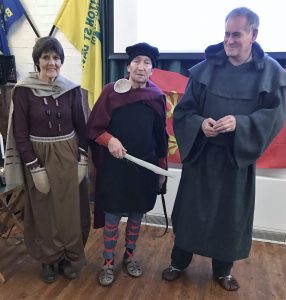
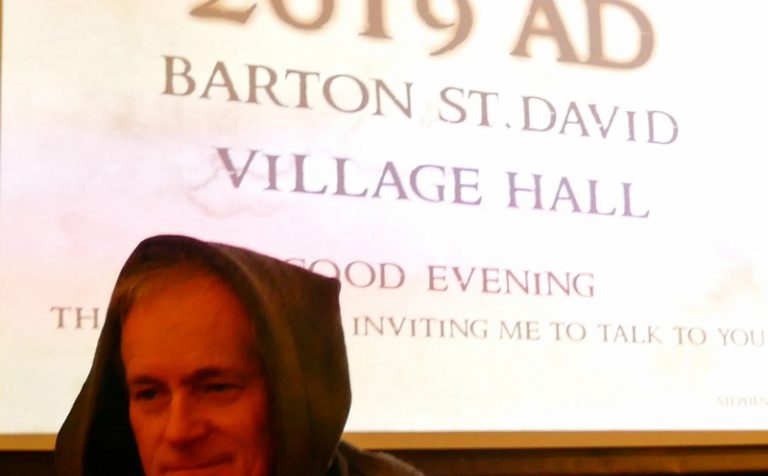
January. Friday 25th, Village Hall, 7.30pm. ‘The Story of Muchelney Abbey 600 to 1066 ‘ 38 Members and guests attended an illustrated candle lit refectory talk by ‘Abbot’ Stephen Honey. Stephen explains Muchelney’s ancient origins, King Ine’s charter, King Alfred’s and King Althelstan’s endowments, Viking rape and pillage and concluded with the Norman invasion. A thrilling story in dark times. Afterwards we enjoyed crusty bread, cheese, relishes, meat pies, ale and other drinks both soft and strong. 3 came in Saxon attire (see below)
2018 December. Thursday 13th, Village Hall, 7.30pm. A ‘What have we here’ evening. 10 diverse and diverting ‘objets curios’ were presented from tokens of Ashanti currency (gold powder) to a working Sinclair micro radio. A short DVD has been made of these items. A BHC produced DVD, recording the Restoration of the Barton War Memorial during Autumn 2018, was shown. This too is available to purchase @ £6, £5 of which will go into BHC funds. Members then enjoyed a glass of mulled wine or fruit juice and a wonderful array of nibbles including Denise Goodman’s famous clotted cream filled mince pies – and our usual conviviality. 34 people attended. It had been agreed this should be a complimentary evening with expenses met from Club funds.
November. Monday 19th, Village Hall, 7.30pm. Fourth of Dr John Little’s powerful WWI centenary lectures. ‘Victory 1918’ proved a gripping insight into the last valiant chapter of a terrible war. John gave a masterful account to an attentive audience of 40 Members and visitors who wolfed down the refreshments after whilst discussing a big ‘what-if’ of history…. what if the Allies had pursued a final conclusion of the War in Germany ?

October. Thursday 18th, Village Hall, 7.30pm. A bumper 48 people came to hear Bernard Sellick and David Daggar talk about their ‘ Photographic Exploration of the Mendips’. They spent 2 years exploring the Mendips with their cameras to reveal surprising facets of the area past and present – henges, roman mines, plague churches, ironworks, ancient fields, vanished villages and much more. The Club welcomed a number of first time visitors from Butleigh, Baltonsborough and Sherbourne. Most enjoyable and interesting evening.
September. Friday 21st, Village Hall, 7 pm. For much of the last 2000 years Church & State were as one. Eminent historian, Dr Robert Dunning, gave a delightfully erudite talk about many ‘Ecclesiastical Obscurities’ now hazily understood – parsons, prebendaries, rectors, tithes, chantries, advowsons, glebes, simony… simony they’ve got it in-fo-my. A pleasing 29 Members and guests attended with refreshments and solace after.
August. Wednesday 22nd. Guided afternoon Tour of Muchelney Abbey. £6 / £5 conc. Free entry with English Heritage membership. 26 people (and very good baby) were taken round Saxon, Norman and later Medieval remains of this Abbey, second only to Glastonbury. Our very able guide was ‘Abbot’ Steven. Some BHC Members kindly conjured up cakes and scones after, with abundant cups of tea to round visit off. ‘Abbot’ Steven will be visiting Barton during 2019 to tell the story of Muchelney from its inception to 1066. And 1066 to its end in 1538.
July. Saturday 21st, Carnival. The BHC stand was this year at the playing field entrance to the Village Hall, so well positioned ! The WW2 Collage prepared by Denise Goodman and Trish Austin was studied and admired. As previously, the Club engaged with a wide range of visitors and viewpoints. Well worth doing in future. Hopefully blessed by another glorious summer.
June. Friday 22nd, Village Hall, 7.30 pm. ‘Desert Island Dates’. This is a new type of Club meeting. The idea, to find Members or visitors prepared to explain what date they would always remember if caste away on a desert island. On this first trial run, 3 people gave short presentations of their ‘date‘. AD 878 was chosen by Peter Robinson (well as sec. he had to come up with something) the year King Alfred overcame the Great Heathen Army under Gunthrum at the Battle of Edington. 1854 was chosen by John Cleland, the year the World’s population grew to 1 billion. George Balcombe chose 31st December 1941, a date which lead him on an amazing set of coincidences involving the restoration of a particular Blenheim Bomber. 3 more diverse ‘dates‘ one would be hard put to dream up ! All in all an interesting and well appreciated evening attended by 15 Members and 1 visitor rounded off by strawberry on cream shortcakes and fizz.
May. Thursday, 24th, Village Hall, 7.30pm. ‘The Romans in Somerset’ John Smith, archaeologist and historian gave a vivid account of roman life. John brought 30 so items from his collection of roman artefacts – tiles, togas, ladies wear, samian and other pottery along with graphic A3 sized pictures. 27 members and visitors were absorbed by John’s presentation and enjoyed anchovy buttered flatbreads, etc. after – but no dormice. There were requests for him to visit us again. A short video diary is available.
April. Monday 16th, Village Hall, 7.30 pm. 19 Members attended. The treasurer’s report shows the Club has a surplus of £671 which was considered a sensible amount in reserve to cover speaker expenses, publication advances and other sundry expenditure – thank you Carolyn for all your hard work in keeping us on the straight and clear. The secretary’s report included a time tunnel video review of the year, which reminded all present of the surprising range of the Club’s activities. Future programme ideas were discussed which included exploration of cider, fossils, lead mining, out-working, a visit to the Rural Life Museum, quarrying, cheese making. Liz Leyshon (for many years manager of Strode Theatre) would be asked as a speaker. The evening ended with fizz and very nice nibbles.
March. Saturday 17th. Tour of Shepton Mallet Prison. 32 people came on this grimly memorable visit. The weather was bitterly cold, more so inside than out ! Howard our guide, had worked as a prison officer until the prison closed in 2013 so knew the place and its history personally. Starting in the yard looking up at the 17 foot + high stone wall and on the spot where firing squads took place, we went on to the ancient part of the prison dating from Elizabethan times, taking in the site of 2 of the 6 fearful treadmills used to power a flour mill and the squalid infirmary. From the exercise yard to the actual prison blocks and then finally to the execution block where the Pierrepoints hung many hundred murderers. There is a good brief history of the prison in Roger Evans ‘Somerset. A chilling history of crime & punishment’ ISBN 978 1 84674 1753
March. Thursday 15th, Village Hall, 7.30pm. ‘SOMERSET FARMS – Then and now’ We had a delightful evening with well known local artist and historian Kate Lynch who documents Somerset farmers and their history. Her illustrated talk using her own paintings, drawings combined with old photographs and oral / video recordings enchanted 46 people – including Pilton (7) and Evercreech, Tintinhull History Groups. Good bread, cheese and refreshments after went down a treat.
February. Thursday 15th, Village Hall, 7.30pm. Clare Blackmore from the Central Western Gazette enchanted 24 BHC members and a guest with ‘Somerset Anecdotes’, most about Barton, drawn from press reports through the 19th century – Mr Look, obviously we would now say an alcoholic, figured serially. Clare endowed the Club with her anecdotes and promises to do further research on Barton press coverage. We wish her publishing endeavours on behalf of a much under rated Wells Folk Poet every success. After the meeting we enjoyed the usual BHC bonhomie. Thanks also to Linda who chauffeured Clare to and fro.
January. Saturday 27th, Village Hall, 7.30pm. For 300 years in England, Village Bands played music for all manner of church and village events. An audience of 51 listened to a 1 hour presentation led by Chas Blacker and the 14-piece Somerset Russets Village Band who re-lived the music these bands played, accompanied by readings from Thomas Hardy and others, illustrating their enlivening role in English Village life. A convivial gathering stayed on after sustained by an excellent Ploughman’s supper & refreshed with warm apple and cider punches. A DVD compilation is available from the Secretary. 2017
December. 43 people came to hear John Stafford’s excellent presentation on the History of the Waggon and Horses (now the Barton Inn). John led the forum using a slide show Powerpoint including photos, maps, old records, newspaper cuttings punctuated with anecdotes from the audience. The evening was rounded off with a sumptuous supper (suggested £4 donation) of good bread, cheese, meats and relishes, mince pies and plenty of convivial socializing. A DVD fly-on-the-wall is available.
November. Saturday, 18th, 7.30pm, Village Hall. BHC prides itself on a varied programme of events and speakers. Frank Reynolds’s theme ‘Laughter is the Best Medicine’ proves the point. On a small stage with an audience of 30 in a half moon around him, Frank, celebrating his 81st birthday on that very night, regaled us for 90 minutes with stories of his childhood (youngest of 14 siblings) and episodes from a fantastical army career. Most people attending decided they had not laughed so much for years. Excellent nibbles after… the special punches went down well also !
October. Thursday 19th, 7.30pm, Village Hall. Eminent archaeologist, Dr Richard Brunning presented the inside story of his extraordinary 30 year work on the ‘Wet and Wonderful World of Avalon’. Richard is famous for his continuing archaeological discoveries in Somerset (eg. Beckery). An audience of 30 attended and enjoyed refreshments and discussion about the era of Barton-upon-Water !
September. Monday 18th, 7.30pm Village Hall. We welcomed Dr John Little back for the third of his powerful lectures in the WW1 series. This time on the ‘ Battle of Messines’ – which produced the loudest man-made sound ever made in human history up to that time. John’s lecture was, as ever, a brilliant evocation of dreadfulness of (trench & tunnel) warfare. A desultory 11 people turned up. After, we shared nibbles and drinks.
August. Wednesday 16th. Glastonbury Abbey guided tour including parts of the museum not open to public. 30 people met at the Abbey’s reception at 1.45 pm ( see gallery ). Entry £5.90 group rate. Luke Loader was our excellent guide. His presentation was later described as a model of how to present a history lesson. Our journey through time and space started with the first priest/hermit endowed land where the future Benedictine Abbey took root and grew into one of the 4 most important & richest institutions in the land until the Dissolution of the Monasteries beginning in 1538. After the tour we gathered in a marquee for tea and a chance to view some of Luke’s favourite archive items including glass fragments from the Abbey’s glass kiln, probably one of the first Medieval kilns established in England. Pointing to St John’s Glastonbury with a tower about 120 feet high, Luke mentioned that it is thought the Abbey’s Tower rose about 270 feet, dominating the landscape for miles around.
July. BHC had a stall at Barton’s Carnival on Saturday, July 15th, to meet folk, explain what we are trying to achieve, hear their views and ( if we are lucky) acquire more items for the village archive. Moments in Time 1 & 2, as well as the 1841 Tithe Maps were on sale. We did get lucky. C 1911 photo of Barton St David Church interior !
June. Monday 19th, 7.30pm, Village Hall. ‘An amazing space, the Story of the Dove Centre’. Bron Bradshaw and Pauline Watson recounted the fascinating story of how this creative powerhouse on our doorstep started 45 + years ago in Copis Cottage (now Dove Cottage), Mill Road and then, with a leap of faith,into Broadmoor Farm on the entry to Butleigh, which required considerable renovation. After many travails the Dove Studios have become a well known and prized Arts Centre for print making, mixed media, furniture, pottery, jewelry, ecological enterprise – viz the ‘White Field’ nature reserve. 26 people attended and were regaled after with chilled rose wine and soft drinks and delicious nibbles. Here’s to Dove Studios long may they prosper ! For more information read their book ‘An AMAZING SPACE’ available from Dove Studios.
May, Thursday 18th, 2pm. The Club arranged a special visit around Midelney Manor, the home of the Trevilian family for over 500 years in deepest Somerset. 27 Members and friends left Barton at 1.30pm to travel in convoy led by Dennis and Janet Powell. Alice, the charming current lady of the manor, took everyone on a tour of both her Elizabethan House and its gardens (set in 400 acres). The visit finished with an al fresco cream tea. By common acclaim it was a special afternoon which will long be talked about. In fact a return visit is planned. The event was the brainchild of Dennis, who organized every detail and even neutralized a poor weather forecast. Thank you again Dennis, brilliant !
April, 2nd AGM, Thursday 20th, 7.30pm, Village Hall. 13 members attended. Club funds are £384; we have 32 paid-up members. The Secretary reported steady growth of the Club archive (images, documents, maps, oral recordings – now over 1000 items), Club display activity (publications, at Carnival, village events), Club members’ research projects citing those of Rob Butt, Denise Goodman and colleagues, John Stafford & David Lawson, who would assist setting up a ‘Buildings at Risk’ group. Home Farm was raised as a possible example. Dennis Powell gave a comprehensive and enlivening review of BHC’s year. There was discussion about future events – a talk from the Clarks archivist, a visit to Glastonbury Abbey set for Wed. 16th August, 2pm. The Club’s second Moment in Time booklet ‘Barton Icons’ was announced. The formal Meeting gave way to refreshments, delicious nibbles and animated chat.
March, Monday 20th, 7.30pm, Village Hall. Bartonian David Lawson’s talk was packed full with practical illustrated advice on ‘Researching & dating old buildings’. David has been in the building trade for 46 years specializing in the restoration of major city heritage buildings. He is a post grad of the Architectural Association in Historic Building conservation. 30 people heard that David’s central approach is ‘ never trust what you are told and always go back to original records if you can’.
February, Thursday 23rd, 7.30pm, Village Hall. ‘The Natural History of Somerset’ Stephen Parker, chair of SANHS (Somerset Archaeological & Natural History Society), gave a vast over view of probably more than 300 species of Somerset’s flora and fauna – many examples unique to the County. 28 people came and were totally fascinated by Stephen’s account. He is an ecologist by profession for Somerset County Council and supremely competent to talk about the ecology of this region. Refreshments were enjoyed by everyone after the meeting
January, Saturday 21st, 7.30pm, Village Hall. ‘The History of Mead’. Our speaker, Brett Johnson, makes mead commercially and has researched mead making historically over the last 5,000 years. A delightful 27 people attended to hear Brett’s account of how mead is made, its place in ancient Greek and old Norse cultures – he has a tremendous grasp of the Norse pantheon of gods and the sagas. However he explained that all was not well in his own entrepreneurial endeavours. He brought a number of different meads for tasting after his talk and a convivial evening ensued.
December, Tuesday 13th, 7.30pm, Barton Inn Skittles Alley. Another ‘What have we here Quizeum No.2?’ Where we bring along personal items of historic interest to challenge and enlighten. A good fun evening with bread & cheese etc. And it was ! 25 people, 12 armed with historical objects attended. Once again Joe and Jenny Fitzgerald kicked proceedings off with a fascinating quiz which included Witches Balls. Refreshments were served on the Village Bier.
November, Thursday 17th, 7.30pm, Village Hall. Bartonian David Odgers FRSA , one of the UK’s foremost advisors on the conservation of historic buildings discussed the grave effect that quarry closures are having on the restoration & repair of our nationally important buildings. 28 people attended an excellent presentation with supporting illustrations. David explained that of the 6000 different kinds of stone amassed into the Sedgwick Stone Collection around 300 only can now be reliably quarried and used. The talk headlined the state of Somerset stone quarries ( much diminished) but necessarily covered the national and international picture also. David has worked on restoration at St Paul’s Cathedral, Buckingham Palace and The Houses of Parliament and is currently involved in the restoration of Audley House. The evening ended convivially with champagne and an array of ‘nibbles’.
October. Thursday 20th. John Denning ‘To be a Farmer’s Boy’. John’s presentation was about farmers and farming around Barton, the iron foundries around Mells, hedging and ditching. Interestingly before mechanization, hedges in Somerset had always been cut 4ft 6in high and wide to accord with human ergonomics. This is what one person had to say about the evening : ‘Yet another glorious triumph! 28 people attended, an interesting talk about farming in Barton, pleasant chat, good wine, excellent nibbles with a superb mustard dip which must have been delivered in the late afternoon from Harrod’s Food Hall – a most enjoyable evening’. October, Wednesday 5th. Many thanks to Tricia and Tony Phelps for organizing a Club visit to John Boyd Textiles Ltd., Castle Cary. 13 people toured the horse hair dyeing & weaving mill. John Boyd have been producing horsehair cloths (and other artefacts) since the mid C19th. We were fascinated by the mechanical picker which pulls one strand of hair at a time to feed to the loom shuttle. This was developed as a result of the 1870 and 1880 Education Acts which stopped the supply of child labour. Up till then children had been doing this key task. Horse hair textiles have wear properties which are 1000 times contract rub test requirement and as with other natural fibres like wool, are naturally fire resistant. The cost per metre reflects its exceptional performance and craft skills – £120 up. A very interesting and enjoyable afternoon. Does anyone have an idea for another BHC visit ? September, Monday 12th. 23 people gathered in the newly re-furbished Village Hall to hear the third in (Dr) John Little’s WWI lectures. The Battle of the Somme had many phases the last being the Battle of the Ancre (Nov – Dec 1916) where General Goff and his 5th Army took the fight to the German forces and landed a series of knock-out blows. John’s lecture was brilliantly researched and presented. We are hoping he will take the story on in 1917 and 1918. The meeting also saw the book launch of the ‘Barton St David Battlefield Tour June 2016’, £5, an excellent account in pictures and word of the memorable visit organized by BHC member Barbara King and John accompanied by 41 people from Barton and surrounding villages.
August, Wednesday 17th. Bizarre Barton 2, the Silver Street Trail. 43 Bartonians and guests met in a field opposite Vine Cottage for a conducted walk up to Gosling Street, then back to Breadstone House, on to Manor Farm and finally, at the kind invitation of John and Sandy Cleland, gathering for Pimms and a rustic platter on what was a splendid summer evening (except for one light shower). Each stopping stop was used to introduce a host of Barton bizarreities about the life and people who had lived along our route over the centuries – of course prompting yet more questions. London Road ? London Inn ? 6 parts of Barton ? The Farm that Time Forgot ? The Teasel growers ? Howard and Sharman Glanfield gave us a tour of Breadstone (Broadstone) House, this act of hospitality and courage (43 to 1) will long be remembered. The 16th century Manor House was the perfect final port of call.
July, Carnival, Saturday 16th July. The Barton History Club’s stand attracted a steady stream of visitors throughout the afternoon. Our first book, ‘Moments in Time’ and the remarkable 1841 Barton Tithe map were on display and respectively, 5 copies of each were sold . We were delighted to be the launch pad for John Dennings’s long awaited book ‘To be a Farmer’s Boy’ – and John was delighted too, he sold & signed 31 copies – all proceeds going to D&S Air Ambulance. 1 membership form was issued and Christine King of Pilton History Group told us about 13 old Postcards they hold of Barton, copies of which she would send us. All in all a very enjoyable and productive afternoon for BHC on, most agreed, one of the best Carnivals. June, Wednesday, 15th. 9 members were given a guided tour of Taunton Museum’s Archive of Somerset Treasures. Our guide, Ben, showed us his favourite exhibits and explained in many cases their national significance in the story of our Island. His selection included the Jade Axe head found by the Sweet Track, the Frome Hoard of 30,000 coins, the Dido and Aeneas mosaic floor and of course King Alfred’s Jewel (reprod). Taunton Museum, recently undertook an £11m re-build and is surely now one of Somerset’s Treasures. If you haven’t visited – don’t leave it too long !
May, Thursday 19th, 7.30pm, Village Hall. Jem Dick, who has been recreating ancient instruments for 30 years, was our guest speaker on ‘the Origins and development of music’. Palaeolithic peoples were not, as we are, separate from the natural world, its flora and fauna. They were totally part of it. Jem lead us into their thinking, through reference to wall art on caves like Lascaux, the recently discovered ‘sweat houses’ at Stonehenge, shaman ritual. And at each stage demonstrated how found objects like animal bones, horns, skins, stones, pine cones could be and probably were musical instruments. He cited the 2 estranged ‘pigmy’ peoples of S.Africa separated for thousand years and by thousands of miles who neither shared language nor way of life but played the identical music. He made the point that to be human is to have music. His talk was exciting and provocative. We hope to invite Jem back ! April, Wednesday 20th, 2.30 pm, held in the Village Hall. ‘A Barton Childhood’. Our speaker, Sue Griffiths’ parents ran the Village shop from Virginia House (now a private dwelling) during the 1950s. Fortunately for us Sue kept and now shares their treasure trove of photos of Barton then – in winter snow and radiant summer. 25 Bartonians attended, many bringing their own memories of people and events to add to the mix. The new projector, screen and headset mike were put to the test and found invaluable. Tea and biscuits rounded off a convivial afternoon gathered round the giant size copy (A0) of the 1841 Tithe Map. The Barton Tudor Dance and Buffet on Saturday 20th February, in the Village Hall was attended by 34 people. Our brilliant dance mistress Anne Hinchcliffe – an advisor to the BBC Wolf Hall epic – announced all would dance and dance all did – sometimes in masques, in the dark holding (electronic) candles, great fun – punctuated with historical snippets explaining the background to the dances. Anne’s musician colleague, Frances Eustace, a specialist in medieval instruments, played tabor and drum, rebec, viol, crumhorn and many more and at the interval explained and demonstrated these instruments. The candle lit Tudor Buffet produced by the Barton Events Group, turned out to be a feast complete with (display) Boar’s Head. One learning to pass on – 34 people is just about the maximum the Hall can hold for a combined meal and dance event. In January 2016 the History Club held 2 meetings. On Sat. Jan. 20th Louise Clapp gave a talk and comprehensive slide show (using the Village Hall’s new super duper projector) on ‘ Baltonsborough. The Past Behind The Present’. It was the first Saturday meeting. 14 came along to hear Louise’s skilful review of 2000 years of Baltonsbury’s past – the buildings, houses, industry, people. The second meeting was on Wednesday, 27th January in Barton Inn’s skittle alley. John Little gave an illustrated talk on research he has undertaken into how the WWI Balfour cabinet enacted National Conscription, when in effect every British male was conscripted into military service – the lame, the insane, all were apparently eligible. Although only 12 people attended, John’s lecture was as ever a masterly account of a turning point in British history on the exact day 100 years after the Act was passed into law. December Quizeum held in the Skittle Alley of the Barton Inn on wed. 16th, 7.30pm. Joe and Jenny Fitzgerald brought along 10 ‘historical’ items for us to identify. Best score was 6. Most 1 or 2. Well how are you on ‘Turkish towel ends ! Then the table was turned and everyone had the chance to present objects they brought along. The diversity was amazing – bow seed spreader, Spitfire camera, U-Boat wheatstone bridge, buried grease gun with WWI tank background, bel monde cigarette holder, eminent Victorian signatures, debris from King Louis Phillipe’s throne, a wrongly dated Edward VII coronation plate … and many more. Sustained by bread, cheese, meats, olives and liquid refreshment the evening continued convivially. About 30 people attended.
November Thursday 12th. Village Hall, 7.30pm. Dr John Little aided by Hayden Davies author and owner of Wells Reclamation, gave a powerful talk in the WW1 series entitled ‘War in the Trenches’ Actually John described the course of the War from Declaration to Amnesty on the 11th hour of the 11th day of the 11th month 1918. 50 people sat gripped for 2 hours! We learnt about trench & tank design, battlefield tactics, the immense resilience of the British army. Refreshment was served in the interval and boy it was needed.
October Thursday 22nd. Village Hall at 7.30pm. Ann Healey a pioneer in the recording of Somerset people, gave a talk illustrated by excerpts from her library of over 600 recordings. 30 Bartonians and a visitor from Ilminster attended. Non members paid £1 at the door. Most stayed after to chat. Wine, soft drinks and savouries were on offer. Club work was displayed in particular the newly released 4 volume BHC Movies ‘Barton Old House Record’ based on original research by John and Barbara Lee in 1988. Early bird price £5 per volume (£4 for BHC members) normal price £7 (£6). September Wednesday 16th. Village Hall. Dennis Chedgy from Radstock Mining Museum gave an enlivening talk to 19 people about the ups and downs of setting up and running a small but perfectly formed museum. Radstock is now a European accredited museum for mining studies. Dennis invited the History Club to come and see for themselves. Sounds like an offer we should take up in the near future. Bizarre Barton Trail/1 ,
Wednesday 19th August 2015. Starting from the Church at 6pm, 33 Bartonians and a dog explored 12 historical Village ‘stepping stones’. These included the Whittle family, the old School House, the new School till 1949, a lost Roman Emperor, Trotters, The Church Farms, the Old Vicarage, Gregorys Orchard, Brook Lanes (both of them). The last ‘stepping stone’ took us to the Skittle Alley of the Waggon and Horses. After liquid refreshment, baguettes, cheese and pate, Rob Butt did a fascinating screen presentation of research he is doing on Barton Landownership from Domesday to the 20th century. Great turnout, well received by all.
| Cookie | Duration | Description |
|---|---|---|
| cookielawinfo-checkbox-analytics | 11 months | This cookie is set by GDPR Cookie Consent plugin. The cookie is used to store the user consent for the cookies in the category "Analytics". |
| cookielawinfo-checkbox-functional | 11 months | The cookie is set by GDPR cookie consent to record the user consent for the cookies in the category "Functional". |
| cookielawinfo-checkbox-necessary | 11 months | This cookie is set by GDPR Cookie Consent plugin. The cookies is used to store the user consent for the cookies in the category "Necessary". |
| cookielawinfo-checkbox-others | 11 months | This cookie is set by GDPR Cookie Consent plugin. The cookie is used to store the user consent for the cookies in the category "Other. |
| cookielawinfo-checkbox-performance | 11 months | This cookie is set by GDPR Cookie Consent plugin. The cookie is used to store the user consent for the cookies in the category "Performance". |
| viewed_cookie_policy | 11 months | The cookie is set by the GDPR Cookie Consent plugin and is used to store whether or not user has consented to the use of cookies. It does not store any personal data. |